Theme images by kelvinjay. Powered by Blogger.

Slider

Google Update

SEO

SMO

FREE SEO TOOL

LOCAL SEO

Google New Audio Content Searchable Update for SEO

Google Wants to Make Audio Content Searchable

Google New Audio Content Searchable Update for SEO

Google wants to change how people discover audio content in search results.

In a recent interview, Zach Reneau-Wedeen of Google’s podcast team details the company’s plans to prioritize audio in the same way it does text, images, and video.

”Right now Google is really good at giving you text and video related to your search query. With all the amazing work podcasters are publishing each day, there’s no good reason why audio isn’t a first-class citizen in the same way.”

One of the ways Google plans to make audio content more searchable is to incorporate podcast metadata into search results.

That means, in addition to podcasts showing up when the title is searched for, podcasts could also be returned in search results when topics and/or people are searched for.

This would involve Google creating a way to learn what each podcast is about, and understanding the content of specific episodes.

”This is something Google has done extremely well for text articles, as well as for images and even more structured data such as maps. We can help with audio, too. It has the potential to help people find the best content for them in that moment, better than they can today.”

In a future where audio content is indexed like text it could open up an entirely new category for marketers— audio SEO.

If audio SEO became a thing it could give way to new forms of audio content altogether, such as spoken-word versions of articles, or short sound clips answering specific questions.

Let’s just hope it doesn’t lead to podcasters repeating words over and over again in attempt to rank for certain keywords.
For More Info - https://bit.ly/2Kis4Lc

Google My Business New Features For All Business users

Google Posts now live for all Google My Business users

After much anticipation, Google Posts is finally available to all small businesses. The content will appear in both Google search and maps results. Google Posts is now rolling out to all small businesses that use the Google My Business (GMB) platform. Google Posts come up in search
Google just announced the rollout late this afternoon. A couple of weeks ago, the company moved Google Posts into GMB, and that is where you can access it now — on both the desktop and the Google My Business Android and iOS apps.
Go to your GMB account and click on “Posts” on the left-side menu when you are in your Google business listing. You can also access it by clicking here.

You should see a screen that looks like this:

Google Business Post When writing a post, you are given several options: upload an image, write text (up to 300 words) or add an event title (with start and end dates and times). Users can also add call-to-action buttons including “Learn more,” “Reserve,” “Sign up,” “Buy” or “Get offer.” Here is a screen shot of that interface:

Google says this give businesses the ability to:


  • share daily specials or current promotions that encourage new and existing customers to take advantage of your offers.
  • promote events and tell customers about upcoming happenings at your location.
  • showcase your top products and highlight new arrivals.
  • choose one of the available options to connect with your customers directly from your Google listing: give them a one-click path to make a reservation, sign up for a newsletter, learn more about latest offers, or even buy a specific product from your website.

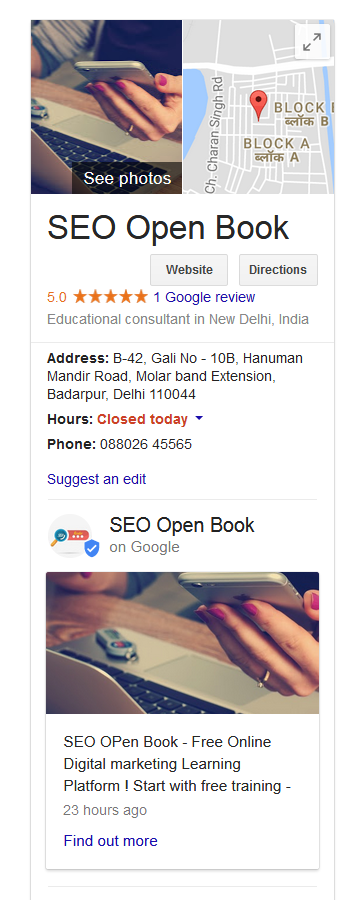
Posts will show up in both Google search and maps results. Here are examples of how Google Posts come up in search:


Google search and maps results

For more details, check out this help document.

Google Posts first launched in January 2016 under the name “candidate cards,” but they were only available initially for political candidates to post content that would show up for relevant political search queries. A couple of months later, the feature was available for a very limited number of small businesses. It has slowly expanded since then until today’s full launch.

Originally Post at - searchengineland.com